
Custom Hockey Stick Manufacturing Guide: Materials, Process & OEM
A complete guide to custom hockey stick manufacturing covering materials, carbon fiber technology, OEM production process, customization options, cost breakdown, and supplier selection for B2B buyers and brands.
5/8/20243 min read
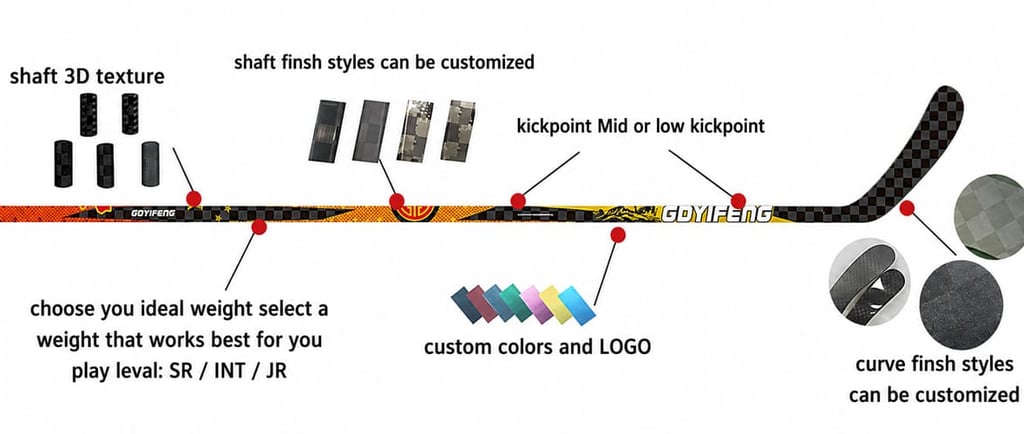
I’ve been working in the sporting goods manufacturing and OEM customization space long enough to see a clear pattern: most buyers underestimate how complex a modern hockey stick actually is.
What looks like a simple sports tool is, in reality, a highly engineered composite product combining carbon fiber layups, resin chemistry, aerodynamic design, and player-specific performance tuning.
In this guide, I’ll walk you through how custom hockey sticks are manufactured from raw materials to finished product, how OEM factories operate, what customization really means, and how to choose the right supplier for your brand or wholesale business.
This is written from a practical manufacturing perspective—not theory.
What Is Custom Hockey Stick Manufacturing?
Custom hockey stick manufacturing refers to the OEM/ODM production process where sticks are designed and produced according to specific brand, performance, or player requirements.
Unlike mass retail sticks from brands like Bauer Hockey or CCM Hockey, custom manufacturing allows:
Brand logo integration (private label)
Custom flex profiles
Blade curve design adjustments
Kick point tuning (low/mid/high)
Material layering optimization
Packaging and branding customization
In B2B trade, this is typically handled by OEM factories in Asia or North America.
Key Materials Used in Hockey Stick Production
Modern hockey sticks are no longer made from wood alone. Today’s high-performance sticks rely heavily on composite materials.
1. Carbon Fiber (Primary Material)
Carbon fiber is the backbone of modern hockey sticks.
Advantages:
Extremely high strength-to-weight ratio
Better energy transfer (shot power)
Lightweight performance
Most OEM sticks use unidirectional or woven carbon fiber layers.
2. Epoxy Resin System
Resin binds carbon layers together.
Its quality affects:
Durability
Flex consistency
Impact resistance
3. Fiberglass Reinforcement
Used in mid-range sticks to:
Increase durability
Reduce cost
Improve impact absorption
4. Foam Core / Polymer Core
Inside blades, manufacturers may use:
EVA foam
Polymer injection cores
Hybrid lightweight cores
Hockey Stick Manufacturing Process (Step-by-Step)
Understanding production helps buyers evaluate suppliers more effectively.
Step 1 – Design & Engineering
Factories or brands define:
Stick length
Flex rating (e.g., 65, 75, 85)
Curve pattern
Kick point geometry
CAD software is used to simulate performance.
Step 2 – Carbon Fiber Layup
Carbon sheets are cut and layered into molds.
This step defines:
Strength zones
Flex distribution
Torque resistance
Step 3 – Mold Compression & Curing
The stick is placed into a heated mold:
High pressure is applied
Resin cures under controlled temperature
Shape becomes permanent
Step 4 – Blade Integration
Blade and shaft are bonded or molded together.
Step 5 – Sanding & Finishing
Surface finishing includes:
Weight balancing
Surface smoothing
Grip texture application
Step 6 – Branding & Printing
Custom OEM options include:
Heat transfer graphics
Paint masking
Logo embedding
Step 7 – Quality Testing
Includes:
Flex consistency testing
Impact resistance tests
Weight control
Customization Options in Hockey Stick Manufacturing
When I work with B2B buyers, customization is usually the most misunderstood area.
Here’s what can actually be customized:
1. Flex Rating
Common ranges:
Junior: 30–50
Intermediate: 55–65
Senior: 70–110
2. Kick Point
Low kick (quick release)
Mid kick (balanced power)
Hybrid kick (versatile)
3. Blade Curve
Changes shot behavior:
Open curve → easier lift
Closed curve → accuracy
4. Grip Type
Matte finish
Soft grip coating
Raised texture grip
5. Shaft Shape
Round
Square
Ergonomic concave
OEM Hockey Stick Manufacturing vs Brand Production
Many buyers ask me the difference between OEM factories and big brands.
Here’s a simplified comparison:
Feature OEM Factory Brand Manufacturer
Cost Lower Higher
MOQ Flexible Fixed
Branding Fully customizable Fixed branding
R&D Basic to advanced Highly advanced
Distribution B2B wholesale Retail focused
OEM suppliers are ideal for startups and distributors.
Cost Breakdown of Custom Hockey Stick Manufacturing
Below is a realistic cost structure based on industry averages:
Component Cost Percentage
Carbon fiber materials 35%
Resin system 10%
Labor 15%
Mold & tooling amortization 10%
Branding & printing 5%
Quality control 5%
Packaging 5%
Factory margin 15%
Key insight: material quality has the biggest impact on pricing.
How to Choose a Hockey Stick Manufacturer
From my experience, buyers often choose factories based only on price—which is a mistake.
Here’s what actually matters:
1. Material Transparency
Ask:
What grade of carbon fiber is used?
Do they disclose resin system?
2. Production Capacity
Can they handle:
Small MOQ orders?
Seasonal bulk orders?
3. OEM Experience
Look for:
Existing export clients
Private label experience
4. Quality Control System
Reliable factories will have:
Incoming material inspection
In-line QC
Final product testing
5. Communication Speed
This is critical in long-term cooperation.
Market Trends in Hockey Stick Manufacturing (2025 Insight)
Based on global B2B demand patterns, I observe:
1. Shift Toward Lightweight Carbon Fiber
Players demand faster stick handling.
2. Custom Branding Growth
More small brands are entering the hockey market.
3. Sustainable Composite Materials
Eco-friendly resin systems are emerging.
4. Direct Factory Sourcing
Retailers increasingly bypass distributors.
Common Mistakes in OEM Hockey Stick Sourcing
I’ve seen many buyers fail because of:
Choosing lowest price over quality
Ignoring flex accuracy testing
Not validating carbon fiber grade
Poor sample evaluation
Lack of long-term supplier strategy
Sustainability in Hockey Stick Manufacturing
Sustainability is becoming important in sports equipment manufacturing.
Some improvements include:
Recyclable carbon composites (limited but emerging)
Reduced resin waste production
Energy-efficient curing systems
Eco packaging solutions
FAQ – Custom Hockey Stick Manufacturing
Q1: What is the minimum order quantity (MOQ) for OEM hockey sticks?
Most factories require 100–500 units depending on customization level.
Q2: How long does production take?
Typically 30–60 days depending on tooling and order size.
Q3: Can I fully customize branding?
Yes, including logo, shaft design, blade graphics, and packaging.
Q4: What is the difference between carbon fiber grades?
Higher-grade carbon fiber provides better strength, lighter weight, and improved responsiveness.
Q5: Are OEM hockey sticks as good as branded ones?
High-quality OEM sticks can match or even exceed branded performance if materials and QC are properly managed.
Get in touch
Share with visitors how they can contact you and encourage them to ask any questions they may have.
Phone
123-123-1234
email@email.com
Professional Hockey Stick Supplier.
Contact
Follow Us
Email:sales@khockeystick.com
Hotline:+8619918080604
© 2026. All rights reserved.


Popular Products
OEM Hockey Sticks
Custom Hockey Sticks
Training & Youth Sticks